Inside Wicked: A Performer's and Director's Guide to the Show

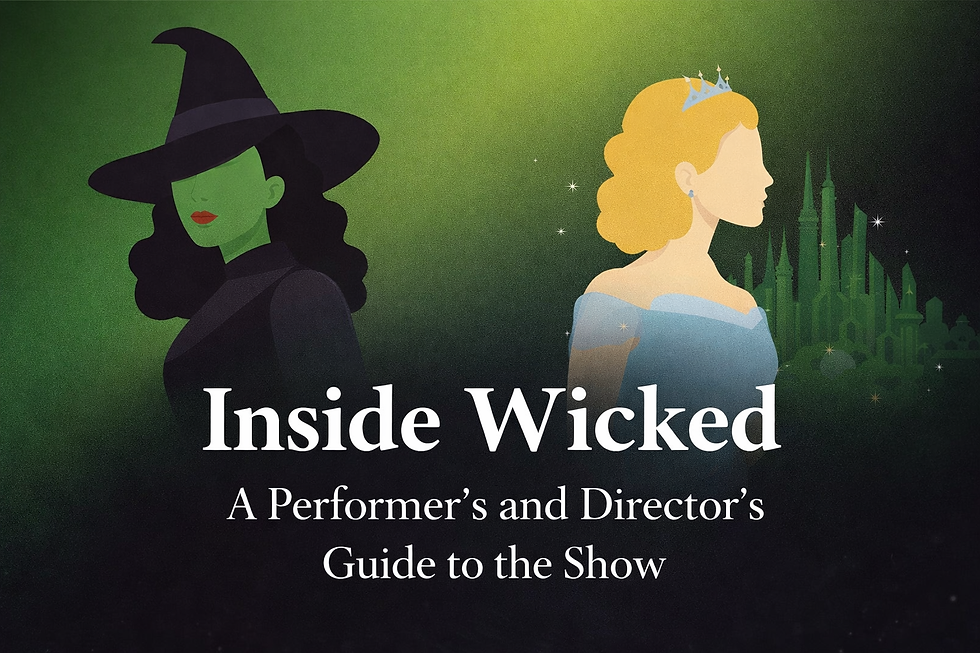
Few modern musicals have had the global impact of Wicked. With its soaring score, complex characters, and breathtaking stagecraft, it has become one of the most recognisable shows in contemporary musical theatre.
Based on Gregory Maguire’s novel, the musical reimagines the story of The Wizard of Oz from the perspective of the so called Wicked Witch of the West. Instead of presenting a simple tale of good and evil, it explores friendship, power, identity, and the cost of standing up for what is right.
Because Wicked is not widely available for licensing to schools or amateur groups, many performers and directors experience it primarily through cast recordings, professional productions, and study rather than staging it themselves. That does not mean there is nothing to learn from it. In fact, it may be one of the most valuable scores to study.
This guide explores what Wicked is about, why it continues to resonate with audiences, the musical and dramatic challenges it presents, and what schools and youth performers can learn from its structure, themes, and score.
What is Wicked About?
At its heart, Wicked is the story of two young women who meet at school and form an unlikely friendship.
Elphaba is intelligent, passionate, and misunderstood. She is born with green skin and faces prejudice from the moment she enters the world. Glinda, by contrast, is popular, ambitious, and socially polished. When they are forced to share a room at Shiz University, they clash at first. Over time, however, they come to understand and respect one another.
As the story unfolds, Elphaba discovers that the Wizard of Oz is not the benevolent ruler he appears to be. The mistreatment of Animals and the manipulation of public opinion reveal a darker political reality. Elphaba refuses to stay silent, even when it costs her safety, reputation, and love.
Glinda chooses a different path. She works within the system, believing she can do good from a position of influence. Their friendship is tested as their choices lead them in opposite directions.
Rather than presenting a simple villain origin story, Wicked asks deeper questions. Who decides what is wicked? How easily can truth be rewritten? And what does it mean to stand by your principles when the world turns against you?
By the end of the musical, the audience is invited to reconsider everything they thought they knew about Oz. The story becomes less about witches and magic and more about perception, power, and the complexity of human relationships.
The History of Wicked
Wicked is based on the novel Wicked: The Life and Times of the Wicked Witch of the West by Gregory Maguire. The book reimagined the world of Oz as a darker political society and explored the backstory of the so called Wicked Witch long before Dorothy arrived.
Composer and lyricist Stephen Schwartz and writer Winnie Holzman adapted the novel for the stage. The musical premiered on Broadway in 2003, directed by Joe Mantello, with Idina Menzel as Elphaba and Kristin Chenoweth as Glinda.
Although early critical reviews were mixed, audiences responded immediately. Word of mouth spread quickly, and the show became a box office phenomenon. Songs such as “Popular” and “Defying Gravity” became modern musical theatre standards.
The London production opened in the West End in 2006 and has run continuously ever since, becoming one of the longest running musicals in theatre history. It has also toured extensively around the world.
Over time, Wicked has developed a reputation as one of the defining musicals of the early twenty first century. Its scale, spectacle, and emotional depth helped shape a generation of performers and theatre audiences.
Even though licensing availability varies by territory and can be limited due to ongoing professional productions and film adaptations, the influence of Wicked on musical theatre is undeniable. It remains a landmark work in contemporary musical storytelling.
Key Themes
Wicked endures not because of spectacle alone, but because of the depth of its themes. Beneath the flying broomsticks and emerald towers lies a story about power, perception, and friendship.
Friendship and Rivalry
At the centre of the musical is the relationship between Elphaba and Glinda. Their bond evolves from rivalry to genuine affection, and eventually to painful separation. The show reminds us that friendship can shape who we become, even when our paths diverge.
Their duet “For Good” captures the idea that people change one another permanently.
Identity and Otherness
Elphaba’s green skin marks her as different from birth. The prejudice she faces reflects broader themes of marginalisation and exclusion. The show asks what it means to embrace who you are when society refuses to accept you.
Being different becomes both a burden and a source of strength.
Power and Propaganda
The Wizard’s regime manipulates fear to maintain control. Animals are silenced. Truth is distorted. Public opinion is shaped through spectacle and misinformation.
The story explores how easily narratives can be rewritten and how quickly a person can be labelled wicked for challenging authority.
Public Image Versus Private Truth
Glinda becomes a symbol of goodness in the public eye, even when she is privately conflicted. Elphaba becomes a villain in reputation, even when her intentions are morally driven.
The contrast highlights how image often overrides truth in political and social systems.
Moral Complexity
Unlike traditional fairy tales, Wicked refuses simple labels of good and evil. Characters make imperfect choices. Motivations are layered. Consequences are complicated.
This moral ambiguity is one of the reasons the musical continues to resonate with modern audiences.
For performers and directors studying the show, these themes provide rich material for interpretation. Wicked is not simply a retelling of a familiar story. It is an exploration of how perspective shapes history and how courage often comes at a cost.
Understanding the Characters
One of the reasons Wicked remains such a powerful study piece for performers is the depth of its characters. Each role demands more than surface level acting. The emotional arcs are layered and require clear intention.
Elphaba
Elphaba is often described as the misunderstood outsider, but that only scratches the surface. She is intelligent, principled, and emotionally guarded. Her journey moves from isolation to empowerment, but at significant personal cost.
For performers, the challenge is to balance vulnerability with strength. Her songs require emotional honesty as much as vocal power. “Defying Gravity” is not just a high note moment. It is a declaration of identity.
Glinda
Glinda begins as socially ambitious and somewhat superficial. However, her arc is subtle and complex. She grows in empathy and self awareness, even while choosing a path of political safety.
Playing Glinda requires comic precision, but also depth beneath the sparkle. The transition from “Popular” to “For Good” must feel earned and sincere.
Fiyero
Fiyero evolves from carefree and detached to morally aware and courageous. His transformation mirrors Elphaba’s, but in a quieter way. He represents the choice to act rather than remain comfortable.
His character arc depends on sincerity rather than bravado.
The Wizard
The Wizard is charismatic and theatrical. He understands the power of image and illusion. For actors, the challenge is to portray charm without losing the unsettling undertone of manipulation.
He is not a simple villain. He is a symbol of power sustained by narrative control.
Madame Morrible
Madame Morrible operates within the political system, prioritising influence over morality. Her presence adds tension and reinforces the theme of propaganda and control.
She must be played with authority and restraint rather than caricature.
For performers studying Wicked, character work is central. The emotional journeys are intertwined, and every decision shapes the larger narrative. Approaching these roles with nuance and intentionality is what elevates the show from spectacle to meaningful drama.
Musical and Vocal Challenges
Wicked is one of the most demanding scores in contemporary musical theatre. For performers studying it, the vocal and musical challenges are significant and should never be underestimated.
Sustained Belt and Stamina
Elphaba’s role is famously demanding. Songs such as “Defying Gravity” and “No Good Deed” require sustained belt, emotional intensity, and precise breath control. The tessitura sits high for extended periods, and stamina is essential.
Without strong technique, vocal fatigue becomes a real risk.
Vocal Contrast and Style
Glinda’s music demands agility, clarity, and stylistic contrast. “Popular” requires rhythmic precision and comic timing, while “For Good” demands warmth and controlled phrasing.
The performer must shift seamlessly between humour and sincerity.
Emotional Acting Through Song
Many numbers carry heavy emotional weight. The climax of “Defying Gravity” is as much an acting challenge as a vocal one. Performers must sustain character intention while managing complex musical lines.
Technique should support emotion, not overpower it.
Layered Ensemble Writing
Schwartz’s ensemble writing often includes counter melodies and harmonised sections that require clean listening and balance. “One Short Day” and “March of the Witch Hunters” depend on clear ensemble precision.
Musical discipline underneath spectacle is essential.
Dynamic Control
The score moves between intimate duets and full scale production numbers. Performers must manage dynamics carefully. Singing at maximum intensity throughout weakens impact and increases fatigue.
Control creates contrast.
For students and professionals alike, Wicked is often used as a benchmark for vocal development. Studying the score builds stamina, breath support, emotional storytelling, and musical precision. It is a masterclass in how technical discipline and dramatic intention must work together.
Directorial Considerations
For directors studying Wicked, the challenge is not simply scale. It is clarity. The spectacle is iconic, but the emotional spine must always lead.
Balancing Spectacle and Intimacy
Large production numbers such as “One Short Day” and “Defying Gravity” are visually expansive. However, the show’s most powerful moments are often intimate. Scenes between Elphaba and Glinda require stillness and emotional precision.
Directors must resist the temptation to let spectacle overshadow character.
Avoiding Imitation
Because Wicked is so well known, performers often arrive with strong preconceptions shaped by cast recordings and viral clips. A director’s task is to encourage interpretation rather than imitation.
Iconic moments should feel truthful to the performer, not like replicas of previous productions.
Clarifying Political Themes
The political subplot involving the Wizard and the treatment of Animals can easily become background noise. Directors should ensure the stakes feel real and understandable. The audience must clearly grasp why Elphaba’s choice to rebel matters.
When the political thread is clear, the emotional climax carries greater weight.
Managing Tone
Wicked shifts between humour and darkness. “Popular” sits alongside “No Good Deed.” Directors must ensure these tonal shifts feel intentional rather than jarring.
Pacing and emotional through lines are crucial.
Supporting Vocal Health
Given the vocal demands, directors must collaborate closely with musical directors to pace rehearsals intelligently. Building stamina gradually and protecting principal voices ensures consistency across performances.
Artistic vision should never compromise performer wellbeing.
Directing Wicked requires restraint as much as ambition. When character, clarity, and emotional truth are prioritised, the spectacle enhances the story rather than overwhelming it. That balance is what makes the musical so enduring.
Why Wicked is Studied So Widely
Wicked has become more than a long running Broadway success. It is now a benchmark piece in musical theatre education and performance study.
A Modern Vocal Standard
For many performers, songs such as “Defying Gravity” and “For Good” are part of the contemporary canon. They test range, stamina, emotional control, and storytelling. Vocal coaches frequently use the score to develop breath support, belt technique, and dynamic contrast.
It is challenging without being inaccessible, which makes it valuable in training environments.
Strong Female Led Storytelling
The musical centres on two complex female protagonists whose relationship drives the narrative. This makes it an important study piece for character development, partnership on stage, and emotional nuance.
Few modern musicals place female friendship so clearly at the heart of the story.
Political and Social Relevance
The themes of propaganda, otherness, and power structures remain highly relevant. Students analysing the show often explore how narrative control shapes public perception.
It opens discussion beyond performance into social and political interpretation.
Structural Craftsmanship
Stephen Schwartz’s score demonstrates clear motif development and thematic musical writing. Directors and musical directors study the score for its structure, pacing, and layering.
The show offers insight into how music and narrative interlock.
Cultural Impact
With two decades of global success, Wicked has influenced casting trends, vocal expectations, and production design across contemporary musical theatre. Its cultural footprint makes it impossible to ignore in serious theatre study.
Even when not available for amateur licensing, Wicked remains one of the most analysed and referenced musicals of its era. For performers, directors, and students, it offers a masterclass in character depth, vocal discipline, and narrative complexity.
Final Thoughts
Wicked remains one of the defining musicals of modern theatre because it combines spectacle with substance. Its soaring score, emotionally complex characters, and layered political themes make it far more than a retelling of a familiar story.
For performers, it is a benchmark of vocal stamina and emotional storytelling. For directors, it is a study in balancing intimacy with scale. For musical directors, it is a masterclass in ensemble layering and dynamic control.
Even when productions are limited by licensing availability, studying Wicked sharpens craft. The lessons in breath control, sustained belt, harmonic clarity, and character intention are transferable to almost any contemporary musical.
If you are working on a licensed production of Wicked, or studying the score in depth, you can explore my full set of rehearsal and backing tracks here:
Structured rehearsal support can help secure complex harmonies, manage stamina across demanding numbers, and build confidence in this vocally challenging score.
Whether performed, studied, or simply admired, Wicked continues to raise the bar for modern musical theatre.


Comments