Les Misérables: A Complete Guide for Schools and Youth Theatre

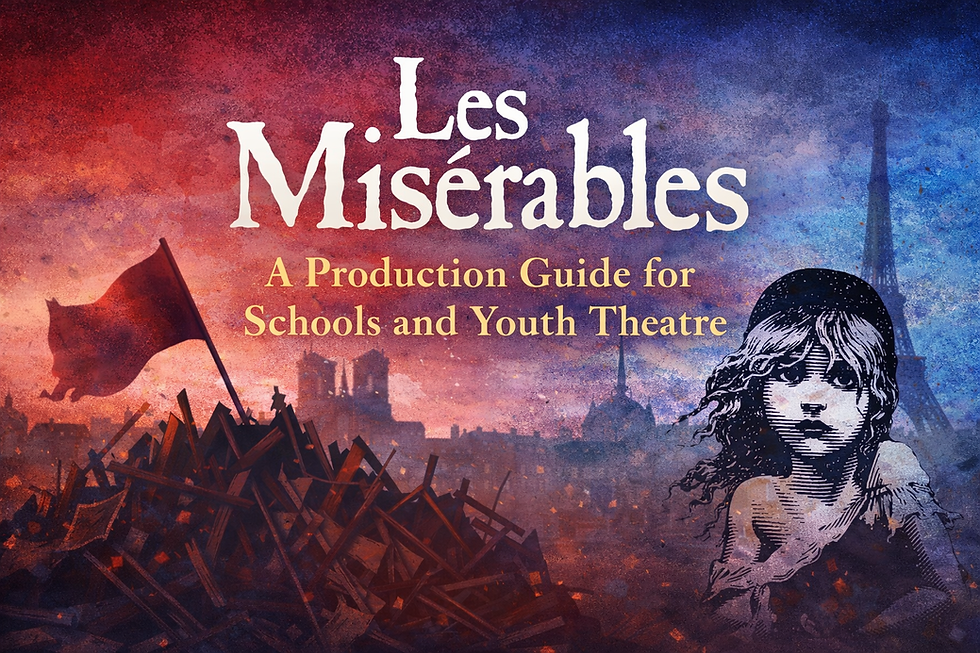
Few musicals carry the emotional weight and global recognition of Les Misérables. It is epic in scale, intimate in its storytelling, and completely uncompromising in its music. For many schools and youth theatre companies, staging this show feels like a milestone moment.
Set against the backdrop of revolutionary France, the story follows Jean Valjean’s lifelong struggle for redemption, love, justice and grace. It moves from factory floors and prison yards to candlelit convents and towering barricades. The stakes are always high, and the emotions are always real.
Musically, Les Misérables is through sung, which means there is almost no spoken dialogue. Every moment is driven by melody, harmony and lyrical storytelling. That makes it thrilling to perform and incredibly powerful to watch, but it also demands preparation, stamina and musical precision.
In this guide, we will explore what the show is about, where it came from, the key themes that make it timeless, and the practical realities of staging it with young performers. Whether you are a director, musical director, performer or teacher, this will help you approach Les Misérables with clarity and confidence.
What is Les Misérables About?
At its heart, Les Misérables is a story about redemption.
The musical follows Jean Valjean, a former prisoner who is released on parole after serving nineteen years for stealing a loaf of bread. Hardened by injustice and rejected by society, he is transformed by an act of mercy from a bishop who chooses compassion over punishment. From that moment on, Valjean dedicates his life to becoming a better man.
However, he is relentlessly pursued by Inspector Javert, a police officer who believes the law is absolute and that criminals can never truly change. Their ideological conflict becomes the spine of the story. It is not just a chase, but a battle between grace and judgement.
Along the way, we meet Fantine, forced into desperate choices to provide for her daughter Cosette. We see Cosette grow into a young woman who falls in love with Marius, a student caught up in revolutionary fervour. Around them are factory workers, students, innkeepers, street children and soldiers, each representing a different face of society.
The story builds toward the June Rebellion of 1832, where young idealists take to the barricades, fighting for freedom and justice. Some are driven by politics, others by loyalty, love or hope. Not all of them survive.
Despite its tragedy, the show ultimately asks profound questions. Can a person change? Does mercy matter more than justice? What do we owe one another as human beings?
It is epic in scale, but deeply personal in its emotional journey. That balance is one of the reasons Les Misérables continues to resonate with audiences of every generation.
History of Les Misérables
Les Misérables began life as a French concept album in 1980. Composer Claude Michel Schönberg and lyricist Alain Boublil adapted Victor Hugo’s 1862 novel into a sung through musical that aimed to capture the emotional sweep of the original story.
The first stage production opened in Paris in 1980. While the initial response was mixed, the score quickly gained attention for its ambition and emotional power. British producer Cameron Mackintosh saw the potential and brought the show to London.
In 1985, the English language version opened at the Barbican Centre in London with lyrics by Herbert Kretzmer. Critics were not kind at first. Some reviews were openly negative. However, audiences responded in overwhelming numbers. Word of mouth spread quickly, and the show transferred to the Palace Theatre and later to the Queen’s Theatre, where it ran for decades. It has since moved to the Sondheim Theatre and remains one of the longest running musicals in West End history.
The Broadway production opened in 1987 and was equally successful, winning multiple Tony Awards and establishing the show as a global phenomenon.
Since then, Les Misérables has been performed in over forty countries and translated into numerous languages. Anniversary concerts at the Royal Albert Hall and large scale arena tours have kept the show visible to new generations. The 2012 film adaptation introduced the story to an even wider audience.
Few musicals achieve true worldwide status. Les Misérables is one of them. It has moved beyond being simply a stage show and become a cultural landmark within musical theatre.
Key Themes
Les Misérables endures because its themes are universal. Although it is set in nineteenth century France, the questions it asks still feel urgent today.
Redemption
At the centre of the story is the idea that people can change. Jean Valjean begins as a man shaped by hardship and rejection. Through compassion, he discovers a different path. His journey suggests that mercy can transform a life more powerfully than punishment ever could.
Justice and Mercy
Inspector Javert represents rigid justice. He believes the law is absolute and unbending. Valjean represents grace and second chances. Their conflict explores a central tension. Is justice about rules, or is it about humanity?
Poverty and Inequality
The world of the musical is marked by deep social injustice. Fantine’s downfall, the struggles of the factory workers, and the lives of the poor in Paris all highlight the cost of inequality. The students on the barricade fight because they believe society can be better.
Revolution and Hope
The uprising at the barricade is driven by idealism. Characters like Enjolras and the students are motivated by hope for a fairer future. Even though the rebellion fails, the spirit of change lives on. The show suggests that hope is not wasted, even when the outcome is tragic.
Love and Sacrifice
Love appears in many forms throughout the story. Parental love, romantic love, friendship, and selfless sacrifice all shape the narrative. Valjean’s devotion to Cosette defines his life. Characters repeatedly give up comfort, safety, and even their lives for others.
For schools and youth theatre companies, these themes provide rich material for discussion and performance. They encourage young performers to explore moral complexity, empathy, and courage. Beneath the scale and spectacle, Les Misérables is ultimately about what it means to choose compassion in a difficult world.
Why Les Misérables Works for Schools & Youth Theatre
Although Les Misérables is epic in scope, it can be a powerful and rewarding choice for schools and youth theatre companies, particularly when staged in the School Edition.
A True Ensemble Experience
Few musicals rely so heavily on collective storytelling. From factory workers to students at the barricade, the ensemble is not background. It is central.
This gives young performers the chance to develop strong choral blend, disciplined staging, and a shared sense of responsibility. The sound of a unified ensemble singing together is one of the most moving elements of the show.
Strong Character Arcs
The principal roles offer real depth. Jean Valjean, Javert, Fantine, Éponine, Marius and Enjolras each have clear journeys that challenge performers emotionally and vocally.
Students are not simply playing archetypes. They are exploring moral conflict, loyalty, love and sacrifice.
Choral and Harmonic Development
Musically, the show is rich in harmony. Numbers such as “One Day More” and “Do You Hear the People Sing” allow young performers to experience layered vocal writing that builds confidence and listening skills.
For music departments, this can be an invaluable learning opportunity.
Emotional Maturity
Older secondary students often respond strongly to the themes of justice, identity and hope. Performing material with genuine emotional stakes can be transformative. It encourages focus, discipline and empathy.
Recognisable and Marketable
The title carries immediate recognition. Audiences are familiar with the music, which makes it an appealing production for ticket sales and community engagement.
When approached thoughtfully and cast appropriately, Les Misérables can become a milestone production for a school or youth theatre company. It demands commitment, but it also builds resilience, ensemble unity and a deep sense of artistic achievement.
Musical Challenges
Les Misérables is one of the most musically demanding shows in the repertoire. Its scale, structure, and vocal writing require discipline from the entire company.
A Through Sung Score
Unlike many musicals, there is very little spoken dialogue. The story unfolds almost entirely through music. This means performers must maintain vocal focus and character intention continuously.
There is no opportunity to reset between scenes. Stamina and concentration are essential.
Complex Layered Harmonies
The ensemble writing is rich and often multi layered. Numbers such as “One Day More” and the barricade sequences require independent vocal lines to interlock precisely.
If timing slips or balance is uneven, the clarity of the music can quickly suffer.
Vocal Range and Stamina
Principal roles sit in demanding ranges. Valjean requires sustained high notes with emotional intensity. Javert’s writing demands control and power. Fantine and Éponine need lyrical strength and breath support.
Because the show runs for a long duration, pacing becomes crucial.
Key Changes and Modulation
The score frequently shifts key to heighten emotion. Performers must feel secure in their pitch and internal pulse to navigate these transitions confidently.
Ensemble members must also remain aware of harmonic movement to maintain blend.
Orchestral Density
Even in reduced orchestrations, the musical texture is full. Singers must project clearly without forcing. Good breath support and vowel consistency help voices carry through dense accompaniment.
In short, Les Misérables requires musical maturity. When rehearsed methodically and with attention to detail, the score becomes breath taking. Without structure, it can feel overwhelming.
Recognising these challenges early allows directors and musical directors to plan rehearsals strategically and protect their cast throughout the process.
Why Preparation Matters
With a show as ambitious as Les Misérables, preparation is not optional. It is the foundation that holds the entire production together.
Securing Ensemble Blend
The power of the show lies in collective sound. When harmonies are confident and entrances are precise, the ensemble feels unified and purposeful.
Early note learning allows rehearsals to move beyond correction and into musical shaping. Blend, balance, and dynamic contrast all improve when performers feel secure.
Supporting Principal Stamina
Leading roles carry significant vocal responsibility. Without careful pacing, fatigue can set in long before opening night.
Structured rehearsal helps principals understand where to conserve energy and where to build intensity. It also protects young voices from unnecessary strain.
Managing Transitions
Because the show is through sung, transitions must be seamless. Tempo control, cue awareness, and clear musical direction prevent momentum from dropping between scenes.
Preparation builds confidence in these moments.
Deepening Emotional Performance
When music is memorised and secure, performers can focus on character intention rather than survival. Emotional truth emerges more naturally when singers are not worried about the next note or entrance.
This is particularly important in songs such as “I Dreamed a Dream” or “Bring Him Home,” where vulnerability must feel genuine.
Building Collective Discipline
Large ensemble productions thrive on shared responsibility. Structured rehearsal outside the main room encourages independence and accountability. When everyone arrives prepared, the entire company benefits.
In a production of Les Misérables, preparation transforms scale into clarity. It protects voices, strengthens ensemble unity, and allows the emotional impact of the score to resonate fully.
With strong foundations in place, the show can achieve the depth and power that have made it endure for decades.
Final Thoughts
Les Misérables is more than a musical. It is an experience.
For schools and youth theatre companies, staging this show can be a defining moment. It demands discipline, maturity, and genuine commitment from the entire cast. Yet when those elements are in place, the result is unforgettable.
The scale of the story, the power of the ensemble writing, and the emotional weight of the score create a production that challenges performers to grow. It builds resilience, teamwork, and musical precision in a way few shows can match.
Approached with care and strong preparation, Les Misérables becomes a milestone production that young performers will carry with them long after the final curtain.
If you are planning a production, you can explore my full set of rehearsal and backing tracks for Les Misérables here:
Having structured musical support outside rehearsal can strengthen ensemble blend, protect principal voices, and help your company navigate the demands of this iconic score with confidence.
With thoughtful preparation and clear musical foundations, Les Misérables can become one of the most powerful and rewarding productions your school stages.

Comments